
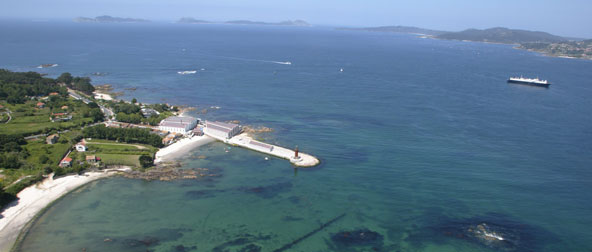
Situated in the province of Pontevedra, the Bay (the Estuary or Ría) of Vigo is the Southernmost of the Galician Rías Baixas (Lower Estuaries).
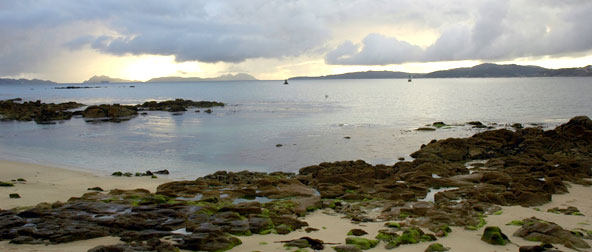
The coastline of the estuary is uneven, with an alternation of small bays —such as San Simón and Redondela as well as the marshland of A Ramallosa to the South, and, to the North, Barra, Liméns, Cangas and Moaña— and peninsulas like Monteferro in the municipality of Nigran (South) and Cape Home (North).
Its more than one hundred beaches make this a most attractive area for tourists. Among these sandy areas are, to the North, Xunqueira, Moaña, Liméns, Barra and Nerga among many others, and, to the South and between Bouzas and Baiona, Samil, Praia América, Panxón and Patos.
In the section between Vigo and Rande the beaches have been lost due to successive harbour expansions, but beyond the Straight of Rande is the Beach of Cesantes. As the flows of sweet river water mix with the salty sea waters a cycle of favourable currents and tides is facilitated, which, in turn, helps the proliferation of shellfish and marine life in general. The Northern coast receives the inflow of rivers Fraga and Pontillón, while on the Southern coast the most important input of fresh waters comes from rivers Verdugo-Oitaben, Miñor, Groba and Lagares.
The rich biodiversity of the Estuary of Vigo is the result of a process through which cold deep Atlantic waters, rich in nutrients, come to surface and replace surface water. The thriving marine resources —including both shellfish and fish— of these waters may at least partly explain the historical developments of Vigo, a city so closely linked to the capture and processing of seafood. And this, in turn, has led to the large-scale urban and industrial expansion of the lands on the waterfront.
The Bay is rich in sardine, squid, sole, octopus, crustaceans like crab and shrimp, and bivalve mollusks like cockle, clam, oyster and mussel. Both oyster and mussel are cultured in rafts, and the more than 500 mussel rafts in the Estuary of Vigo make this the second in output after the Estuary of Arousa. Strongly eroded granite formations (some with a height of over 600 m or 1,970 ft) like Domaio, Galleiro and Galiñeiro enclose the Bay. Also, a number of protected natural shelters allow the visitor to enjoy the Ría, including the Bay of San Simón, the marshlands of A Ramallosa, Cape Home and the Estelas and Cíes Islands.

Avenida Atlántida 160. 36208 Vigo.
T 986247750
F 986247748
Facebook | Twitter | Contact | Work With Us | Amigos do Museo do Mar